
CGUS Invades Mexico
As the Continuity Government of the United States launches a military incursion into northern Mexico, international leaders warn the move reflects deeper instability following last summer’s sea wall collapse and a devastating winter that strained U.S. governance. Mexico and global observers condemn the action as a violation of sovereignty, raising fears of wider regional destabilization.
Elena Marrow, InterWorld News Network (IWN), Mexico City
4/25/20654 min read

Mexico City, April 24, 2065 (IWN) — The Continuity Government of the United States (CGUS) launched a large-scale military incursion into northern Mexico early Thursday morning, crossing multiple border points in what Mexican officials have condemned as an unprovoked violation of national sovereignty and international law.
According to Mexico’s Secretariat of National Defense, CGUS armored convoys, aerial surveillance platforms, and electronic warfare assets entered the states of Sonora and Chihuahua shortly before dawn. Communications disruptions were reported in several municipalities near the border, complicating civilian coordination and emergency response efforts as CGUS units advanced beyond immediate frontier zones.
CGUS officials confirmed the operation hours later, describing it as a “continuity stabilization action” aimed at neutralizing non-state actors allegedly exploiting post-collapse instability. Mexican authorities rejected the justification outright, stating that no joint operations were requested, authorized, or discussed through diplomatic channels.
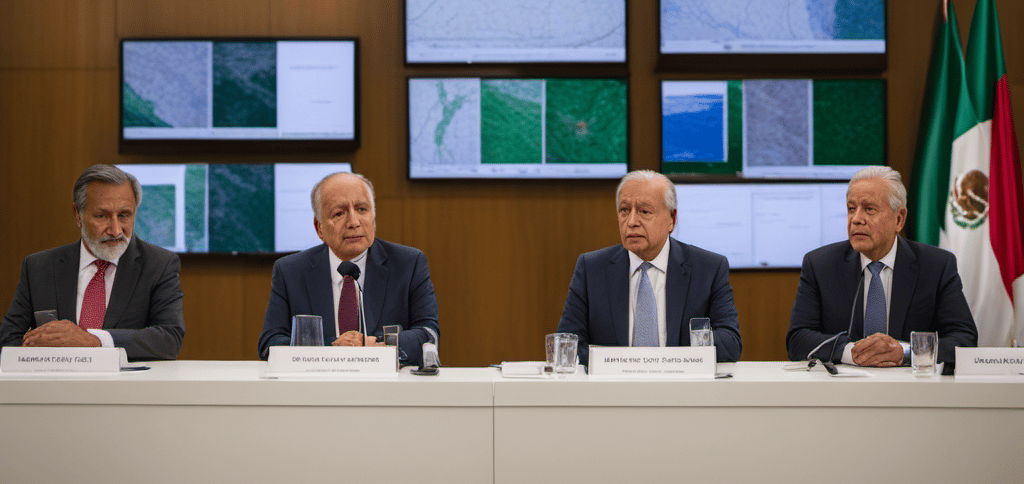
“This is not a security partnership,” Mexico’s foreign minister said during an emergency press briefing in Mexico City. “This is a foreign military incursion onto Mexican soil.”
Escalation After Months of Defiance
The invasion follows months of rising tension between the CGUS and the international community over unresolved allegations that dozens of elected U.S. officials vanished during emergency consolidation measures after the collapse of the eastern sea walls in early August of last year, a disaster that triggered mass displacement and the effective breakdown of federal civilian governance.
Repeated requests by the United Nations for independent audits, humanitarian inspections, and proof-of-life documentation were consistently refused or delayed by CGUS authorities.
UN briefings indicate that at least 27 members of Congress, multiple state governors, and senior federal officials remain unaccounted for. While CGUS leaders insist the officials were “relocated for their protection,” no registries, locations, or third-party verification have been provided.
Mexico formally joined the UN audit request earlier this spring after detecting increased CGUS drone activity, signals intelligence collection, and reconnaissance flights operating near—and in some cases within—Mexican airspace. Diplomatic sources say Mexican officials warned privately that continued opacity would be interpreted as deliberate concealment.
Within weeks, CGUS forces began repositioning along the border.
A Long, Unstable Winter
International analysts emphasize that the timing of the invasion cannot be understood without examining the extended and destabilizing winter that followed the late-summer collapse of the U.S. sea wall system.
“This was not a clean seasonal transition,” said Dr. Amélie Kovač, a senior fellow at the European Institute for Strategic Stability. “The CGUS entered winter already fractured—millions displaced inland, emergency housing incomplete, fuel and food logistics under strain. The pressure accumulated for months.”
According to Dr. Kovač, the unusual sequence—catastrophic infrastructure failure in late summer followed by a brutal winter—left little time for stabilization before cold weather set in.
“Emergency governments rely on momentum and legitimacy,” she said. “The CGUS lost both over the winter. When spring arrived, external action became a way to reassert control and redirect internal frustration.”
Several analysts noted that the April timing aligns with thawing terrain and restored mobility for heavy armor, suggesting the operation was planned around seasonal recovery rather than sudden intelligence developments.
Signs of a Sustained Operation
Military analysts reviewing satellite imagery note that the composition of CGUS forces suggests preparation for a prolonged presence rather than a limited strike. Convoys include fuel tankers, mobile command vehicles, engineering units, and temporary base infrastructure—assets typically associated with occupation or buffer-zone enforcement.
Residents in affected regions report the rapid establishment of secured transport corridors, checkpoints along major highways, and enforced airspace restrictions. Low-flying drones and armored patrols have been observed well beyond initial border crossings.
“This does not resemble a counterterrorism raid,” said one European defense analyst. “It resembles territorial control.”
CGUS military leadership has declined to outline operational boundaries, timelines, or conditions for withdrawal.
Emergency Rule Turned Outward
Since the sea wall collapse, the CGUS has governed under extended emergency statutes, deferring national elections, consolidating legislative authority into an unelected Emergency Continuity Council, and placing portions of the judiciary under military oversight. Officials argue these measures are temporary and necessary for survival.
Critics counter that the invasion of Mexico marks a decisive shift—from internal consolidation to outward coercion—despite collapsing civilian infrastructure and contested legitimacy at home.
“When accountability becomes a threat, expansion becomes a tool,” said a former U.S. constitutional adviser now working with an international monitoring group.
International Fallout
An emergency session of the UN Security Council was convened within hours of the incursion. Several member states called for sanctions, arms embargoes, and travel bans targeting CGUS leadership. Others urged caution, warning that escalation could further destabilize global energy, food, and migration systems already strained by cascading crises.
China and the European Union issued a rare joint condemnation, calling the invasion reckless and unlawful. Brazil emphasized the need to prevent continental destabilization and warned that prolonged conflict could disrupt critical agricultural and trade corridors across the Americas.
Notably absent from official responses was any statement from the United Orbital Colonies, whose silence has fueled speculation about widening fractures between Earth-based continuity regimes and off-world governance.
A Region on Edge
As CGUS forces continue to entrench themselves deeper inside Mexican territory, the invasion raises urgent questions about intent and precedent. Analysts suggest the operation may serve multiple purposes: deflecting international scrutiny, projecting strength to domestic audiences, and establishing strategic depth amid fears of further internal unrest within the CGUS itself.
For Mexico, the challenge now lies in defending its sovereignty while avoiding a wider conflict with a nuclear-armed neighbor in political freefall. For the international community, the invasion underscores a sobering reality—that the Continuity Government may no longer view international norms as constraints, but as obstacles.
What began as a late-summer catastrophe has now evolved into a hemispheric crisis.
© 2025. All rights reserved.
Stay Informed, Stay Connected
Get real-time updates on global news developments.